
5. Notholirion Wall. ex Boiss., Fl. Orient. 5: 190 (1882).
Taxon Description
Perennial, herbs. Bulbs narrowly cylindric; covered with brownish, papery, tunics; sometimes numerous small, ovoid bulbils replaced bulb, which also covered with tunics. Stems erect, leafy, unbranched. Leaves alternate, sessile, linear to linear-lanceolate, apex blunt or subacute, margin entire, veins parallel. Inflorescences a terminal raceme, few- to many-flowered; bracts usually linear or leaf-like. Flowers bisexual, weakly zygomorphic, or actinomorphic, campanulate to funnel shaped, drooping; pedicel usually short, recurved, become erect at fruiting. Tepals 6, usually lilac, mauve, or purple, unequal, free. Stamens 6, inserted at base of tepals; filaments filiform; anthers dorsifixed. Ovary 3-loculed, ovules many per locule; style slender; stigma 3-lobed, lobes slightly recurved. Fruit a loculicidal capsule. Seeds many per locule, flat, with narrow or scarce wings all around.
Taxon Statistics
Five species from SW Asia, W Himalaya, E Himalaya, E Asia, and Assam-Burma. At least two species native to Nepal. Notholirion thomsonianum (Royle) Stapf. is a doubtful species for Nepal.
Key to Genera
1 a. Plants over 60 cm; inflorescences > 10-flowered raceme…………………………..….1. N. bulbuliferum
b. Plants under 35 cm; inflorescences 2-7-flowered raceme…………………………….2. N. macrophyllum
1. Notholirion bulbuliferum (Lingelsh.) Stearn, Kew Bull. 5(3): 421 (1950).
Paradisea bulbulifera Lingelsh., Repert. Spec. Nov. Regni Veg. Beih. 12: 316 (1922); Lilium hyacinthinum E.H.Wilson; Notholirion hyacinthinum (E.H.Wilson) Stapf
Taxon Description
Perennial herbs, more than 60 cm tall. Bulbs tunicate, disappearing when flowering occurs; bulbs replaced by mass of tiny, ovoid bulbils, 5–6 × 4–5 cm, which surrounded by brownish, papery tunics. Stems leafy, simple, erect. Basal leaves alternate, simple, sessile, linear or lorate, 10–25 × 1.5–2.5 cm; cauline leaves linear laneolate, 8–18 × 0.8–2 cm, subacute apex, margin entire, veins many, parallel. Inflorescences racemose, with more than 10 flowers; like bracts, linear-lanceolate, leaf- 2.5–7 × 0.2–0.4 cm. Flowers bisexual, zygomorphic, campanulate, held horizontally; pedicel short, 1–3 mm, recurved by flowering. Tepals lilac, mauve or purple, darker near base adaxially, usually spreading, obovate or oblanceolate, unequal, inner slightly broader than outer, outer 3.5 × 1–1.2 cm, inner 3.5 × 1.2–1.5 cm, apex blunt. Stamens scarsely shorter than tepals; filaments filiform, ca. 3 cm; anthers dorsifixed, ca. 5 mm. Ovary narrowly cylindric, ca. 1 cm; style ca. 3.2 cm; stigma short, 3-lobed, lobes recurved. Capsule loculicidal, oblong to obovoid-oblong, 1.6–2 × ca. 1.5 cm, obtusely angular. Seeds many, flat, narrowly or scarcely winged all round.
Distribution: Nepal, E Himalaya, Tibetan Plateau, E Asia, and Assam–Burma.
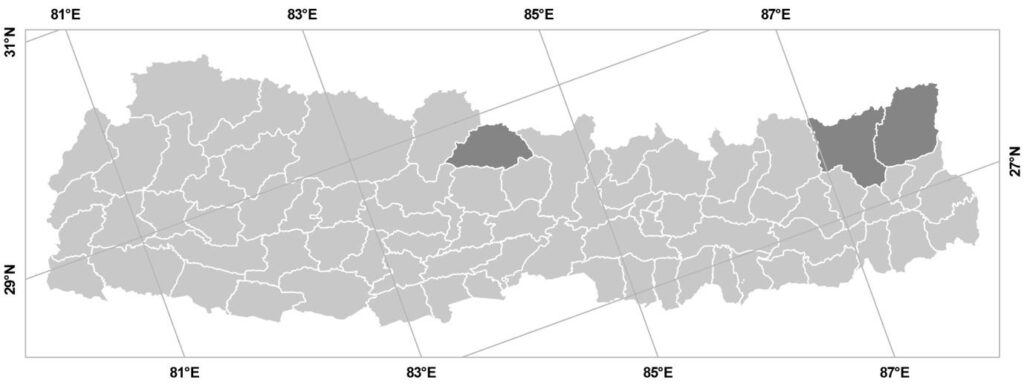
Altitudinal range: (1800–)3000–4500 m.
Ecology: Forests, among sedges and ferns, thickets, alpine grassy slopes.
Flowering: July–August. Fruiting: August.
2. Notholirion macrophyllum (D.Don) Boiss., Fl. Orient. 5: 190 (1882).
Fritillaria macrophylla D.Don., Prodr. Fl. Nepal.: 51 (1825); Lilium hookeri Baker
Taxon Description
Perennial herbs, 15–35 cm tall, Bulbs 1.5–5 × 1.2–2.5 cm; with whitish scales of 2.5–4.5 × 1–2 cm; covered with brownish, papery tunics, 3.5–5 cm. Stems leafy, simple, erect, glabrous. Basal leaves linear lanceolate, 14–35 × 1.5–2 cm; cauline leaves alternate, sessile, lanceolate or linear lanceolate, 8.5–35 × 0.2–1.5 cm, apex blunt, margin entire, veins many, parallel. Inflorescences 2–5(–7)-flowered raceme; bracts narrowly linear, leaf-like, 1.2–1.5 cm long. Flowers bisexual, weakly zygomorphic, campanulate, held horizontally; pedicel 1–2.2 cm, slightly recurved. Tepals lilac, mauve, or pale purple, sometimes darker at base adaxially, oblong-oblanceolate, unequal, inner slightly broader than outer, outer 2.5–5 × 0.6–1 cm, inner 2.5–5 × 0.9–1.8 cm, base narrow, apex obtuse or rounded. Stamens slightly shorter than tepals; filaments 1.7–2.2 cm, filiform; anthers dorsifixed, 0.4–1.5 cm. Ovary cylindric, 0.6–1.2 cm; style 2.5–3.5 cm; stigma 3-lobed, lobes recurved. Capsule loculicidal, oblong, 1.4 × 1 cm. Seeds many per locule, flattened, irregular triangular.
Distribution: Nepal, E Himalaya, Tibetan Plateau, and E Asia.
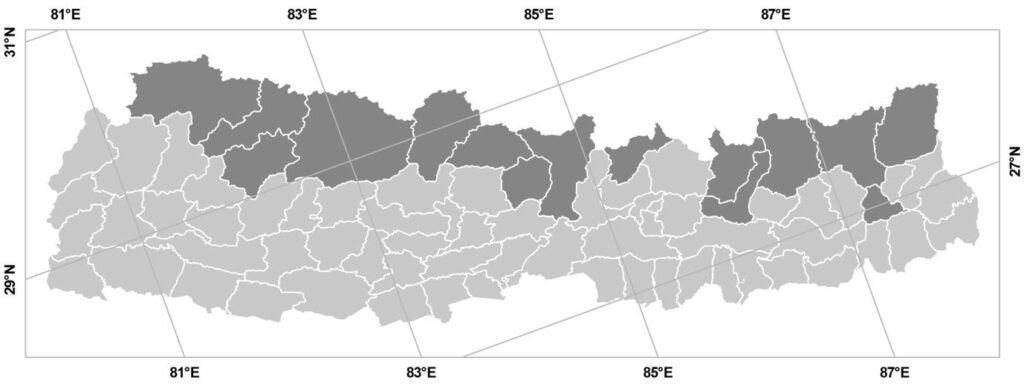
Altitudinal range: 2500–4400 m.
Ecology: Coniferous, mixed, or broadleaved forests; moist or shady grassy slopes; rocky places; alpine meadows.
Flowering: July–August. Fruiting: August–October.