
2. Lilium nepalense D.Don, Mem. Wern. Nat. Hist. Soc. 3: 412 (1821).
Taxon Description
Lilium ochroleucum Wall. ex Baker
खिरौँला, खिरौँले, बनलसुन Khiraunlaa, Khiraunle, Banlasun (Nepali), Nepal lily (English).
Perennial herbs, 30–150 cm tall. Bulbs on a creeping rooting stem, subglobose, 1.5–4 × 2–5 cm; scales 8–12, yellowish-brown, ovate to ovate-lanceolate, 1.5–2 cm wide. Stems simple, erect, leafy, glabrous. Leaves scattered or alternate, sessile or shortly petiolated, elliptic to oblanceolate, 4–14.5 × 0.7–3.5 cm, apex subacute to acuminate, margin entire, both surfaces glabrous, veins parallel, 5–7. Inflorescences a single terminal flower or flowers 2–3; bracts 4–5, leaf-like, arranged in whorl. Flowers large, funnel shaped, drooping; pedicels 3–10.5 cm. Tepals pale yellow to greenish yellow above, tinged purplish or crimson-brown at base, lanceolate, unequal, outer 6–13.5 × 1.2–2.5 cm, inner 6–13.5 × 1.5–3 cm, base narrow, apex strongly reflexed, obtuse; basal nectarines present adaxially, surface not fringed. Filaments 6–9.5 cm, subulate, glabrous or papillose; anthers orange yellow to brown, 1–1.5 cm, dorsifixed. Ovary cylindric, 1.2–1.5 × 0.2–0.3 cm; style 7–9 cm; stigma brown, 3-lobed. Capsule loculicidal, oblong, 3–5.5 × 1.5–3.5 cm. Seeds many, thin, flattened, winged.
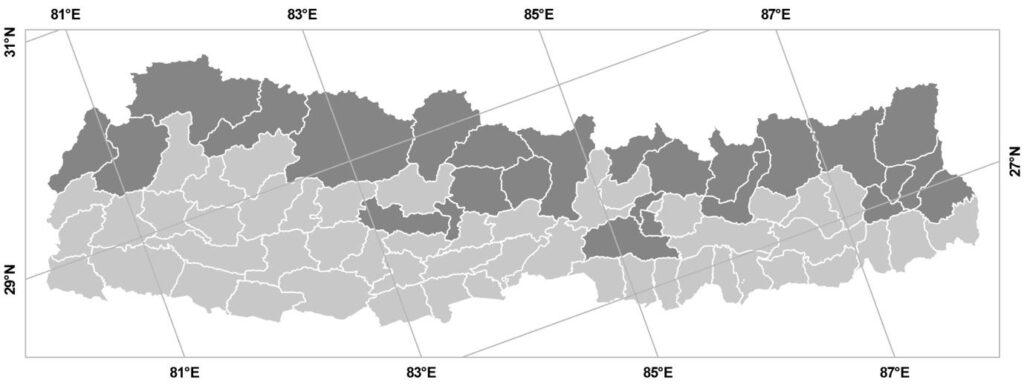
Distribution: Nepal, W Himalaya, E Himalaya, Tibetan Plateau, Assam–Burma, E Asia, and SE Asia.
Altitudinal range: 1500–3800 m.
Ecology: Wet and shady places in forests, forest margins, thickets, grassy slopes, steep rocky slopes, and beside streams.
Flowering: June–August. Fruiting: August–September.
Bulbs are used in medicine; roasted bulbs are eaten.