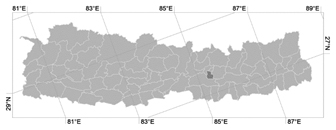
6. Tradescantia L., Sp. Pl. 1: 288 (1753).
Zebrina Schnizl.
Taxon Description
Perennial herbs. Roots fibrous. Rhizomes absent. Stems decumbent, forming colonies, trailing or creeping. Leaves alternate or spiral, lanceolate to ovate, slightly pubescent, sheaths vaginate, open, margin entire or slightly undulate. Inflorescence terminal or lateral, solitary, fascicled, or forming a panicle, sessile, involucral bracts ovate, lanceolate sometimes elliptic, mostly spathe-like, filiform, not penetrating the leaf sheath and emerges through the mouth of sheath. Flowers bisexual, actinomorphic. Pedicels present. Sepals 3, free or connate at base, boat-shaped. Petals 3, free or with claws fused at base, ovate, white or pink. Stamens 6, all fertile, subequal or antipetalous 3 shorter, filaments glabrous or bearded, anther locules ellipsoid or oblong, longitudinally dehiscent. Ovary 3-loculed, ovules 2 per locule. Capsule 3-valved, ovoid. Seeds 1–2 per valve, cylindric, trigonous, rugose, reticulate, hilum linear.
Taxon Statistics
1. Tradescantia fluminensis Vell., Fl. Flumin.: 140 Pl.152 (1829).
Tradescantia albiflora Kunth.
Perennial herbs, 3–26 cm. Rhizomes absent. Stems branched, prostrate and forming dense mats or colonies, rooting from lower nodes. Leaves sessile, alternate, dark green and purplish below, ovate or ovate-lanceolate, 1.5–4 X 1–1.5 cm, margin entire, ciliate base rounded, apex acute, shiny, clasping the stems, sheath 4–8 mm, glabrous, ciliate along margins and mouth. Inflorescence terminal with clusters of flowers subtended by 2 leaf-like bracts, involucral bracts typically ovate to lanceolate, apex usually acute or slightly acuminate. Pedicels present. Flowers pedicellate, pedicel hairy, 0.5–1.3 cm, slender. Sepals 3, 2–5 mm, green, lanceolate, hairy on back along keels, persistent and enclosing the floral parts. Petals 3, 2–5 mm, white, ovate-lanceolate, apex acute. Stamens 6, fertile, sub-equal, filaments with white beards from base, yellow. Ovary 3 loculed, ovules 1 or 2 per locule. Capsule 3-valved, ovoid. Seeds 1 or 2 per valve, light grey, sub-pyramidal, 1.2–3.8 mm, rugose reticulate, hilum linear, minute.
Distribution: Native to South America (Brazil to northern Argentina); naturalized in Nepal.
Altitudinal range: 1300–1400 m.
Ecology: Occurs as a weed in open places along roadside.
Flowering: April–June.
Fruiting: August–November.