
4. Sagittaria , Sp. Pl. 2: 993 (1753).
Taxon Description
Perennial, aquatic herbs. Roots fibrous. Stems tuberous, sometimes corms, often stoloniferous. Leaves sometimes dimorphic, floating or aerial leaves petiolate, with distinct veins, parallel with margins and converging towards apex. Scapes erect or decumbent, inflorescences racemose, with 3-flowered whorls, each subtended by lanceolate bracts connate at their bases. Flowers unisexual or bisexual, with male flowers in the upper part of the inflorescence and female or bisexual flowers below. Sepals 3, green, free, persistent, reflexed or not after anthesis, ovate to lanceolate, slightly boat shaped. Petals 3, free, white, with or without a basal spot, very delicate. Stamens numerous, yellow, spirally arranged, anthers basifixed. Carpels free, numerous, spirally arranged, style terminal, persistent, ovule 1. Fruit a head of achenes. Achenes green, laterally compressed with a persistent stylar beak, margins winged.
Taxon Statistics
About 40 species worldwide, especially in tropical and temperate regions. Two species in Nepal.
Key to Species
1a Scapes decumbent, spreading. Leaves floating or submerged, broadly ovate to cordate. Sepals erect after anthesis. Achenes with cristate wing, oblique beak arising adaxially……………………….…..…………1. S. guayanensis
b Scapes erect, ascending. Leaves aerial, sagittate. Sepals reflexed after anthesis. Achenes with non-cristate wing, erect beak arising apically ………………………………………………………………………………….…… 2. S. trifolia
1. Sagittaria guayanensis subsp. lappula (D. Don) Bogin., Mem. New York Bot. Gard. 9: 192 (1955).
Sagittaria lappula D.Don, Prodr. Fl. Nepal.: 22 (1825); Alisma lappula Buch.-Ham. ex Kunth; Lophotocarpus guayanensis var. lappula (D.Don) Buchenau.
वन रभेगा Ban rabhega (Nepali).
Herbs to 60 cm. Stolons absent, corms present, tubers not seen. Leaves dimorphic, submerged leaves phyllodial, linear-lanceolate, (2.5–)3.5–10(–25) X 0.2–0.6 cm, apex acute; petiolate leaves submerged or floating, broadly ovate to cordate, 1.5–9.5 X (1–)2–7.5 cm, apex obtuse, margin entire, petioles 8–50(–60) cm. Scapes decumbent, floating or partly submerged. Inflorescence raceme, 7.5–50(–60) cm. Flowers mostly unisexual. Pedicels of male flowers 1–2.5 cm, 0.9–2 cm in female flowers. Sepals 0.4–1.4 X 0.3–1.5 cm, apex acute, margin entire, persistent. Petals obovate, subequal to sepals, with or without purple basal spot. Stamens 8–15, anthers yellow, oblong, basifixed, ca. 2 mm, filaments dilated at base, slightly longer than anthers, glabrous. Style short, ca. 1 mm. Fruiting heads 1.8–2.2 cm, enclosed by sepals. Achenes obovoid to elliptic, 3–4 mm, with broad blunt, spiny crest, margin unequally keeled, adaxial beak oblique. Seeds brown, 1.5 mm across.
Distribution: Nepal, W Himalaya, E Himalaya, Assam-Burma, S Asia, E Asia, SE Asia, SW Asia; and Africa.
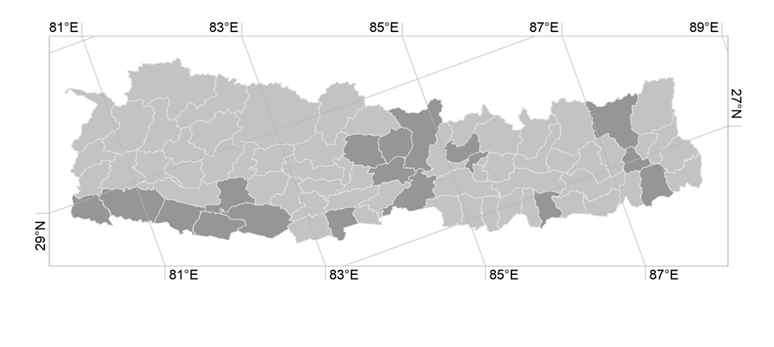
Altitudinal range: 100–1000(–1300) m.
Ecology: Ponds, lakes, marshes, ditches, paddy fields, channels. Occasionally in temporary ponds and ditches.
Flowering: July–September, Fruiting: July–November.
Plants used medicinally and the tubers are used as food and fodder.
2. Sagittaria trifolia L., Sp. Pl. 2: 993 (1753).
Sagittaria hastata D. Don; Sagittaria leucopetala (Miq.) Bergmans; Sagittaria sagittifolia var. alismifolia Makino; Sagittaria sagittifolia var. leucopetala Miq.
कानपाते Kaanpate (Nepali).
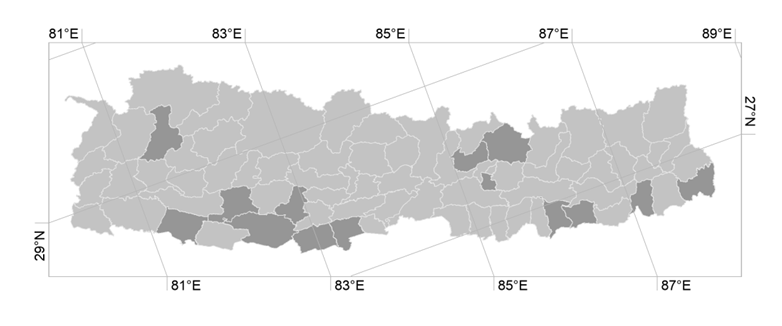
Distribution: Nepal, W Himalaya, E Himalaya, Tibetan Plateau, Assam-Burma, S Asia, E Asia, SE Asia, N Asia, C Asia, SW Asia.
Altitudinal range: 100–1700 m.
Ecology: Ponds, streams, paddy fields, wet places, and marshy areas. Occasionally in shallow water.
Flowering: May– September. Fruiting: June–November.
Aerial shoots used as fodder. Tubers are rich in sugar and can be eaten.