
1. Butomopsis , Enum. Pl. 3: 164 (1841).
Taxon Description
Annual or perennial, aquatic herbs. Roots fibrous. Leaves petiolate, aerial, mid vein parallel with lateral veins and converging toward apex. Scapes erect, inflorescence an umbel, bracts persistent, lanceolate, forming an involucre. Flowers bisexual, pedicellate. Sepals 3, persistent. Petals 3, free, white, slightly longer than sepals. Stamens usually 8 or 9, anthers basifixed. Carpels free, 6–9, arranged in a single whorl, greenish yellow. Fruit a head of follicles with persistent stylar beaks. Seeds numerous, mostly winged.
Taxon Statistics
Worldwide only one species. One species in Nepal.
1. Butomopsis latifolia (D. Don) Kunth., Enum. Pl. 3: 165 (1841).
Butomus latifolius D. Don, Prodr. Fl. Nepal.: 22 (1825); Butomopsis lanceolata (Roxb.) Kunth; Butomus lanceolatus Roxb.
कर्कले झार Karkaley jhar (Nepali).
Herbs to 50 cm. Leaves in basal rosette, petioles 23–40 cm, sheathing, rarely exceeding the inflorescence, narrowly elliptic to lanceolate, 4.5–10.5 X 0.7–3 cm, base attenuate, apex acute, margin entire, veins 8–10, somewhat parallel to the margins and connected by transverse veins. Inflorescence 23–40 cm, bracts lanceolate to slightly triangular, 0.9–1.1 cm. Pedicels 1.5–9.5 cm, enlarging in fruit. Sepals green, broadly elliptic, 5–7 X 3–4 mm, apex acute to bluntly acuminate, margin membranous, persistent. Petals obovate, 4–6 mm, margin membranous, irregular, very delicate. Stamens 8–9, arranged in 3 whorls, anthers yellow, oblong, basifixed, 0.7–1.5 mm, filaments 1.5–3 mm, glabrous. Carpels 6–9, 2.5–5.5 mm, enlarging in fruit. Follicles oblong, 8–10 X 2.5–3 mm, apex acute, tapering to apical stylar beak. Seeds brown, up to 0.5 mm.
Distribution: Nepal, E Himalaya, Assam-Burma, S Asia, E Asia, SE Asia; Africa and Australasia.
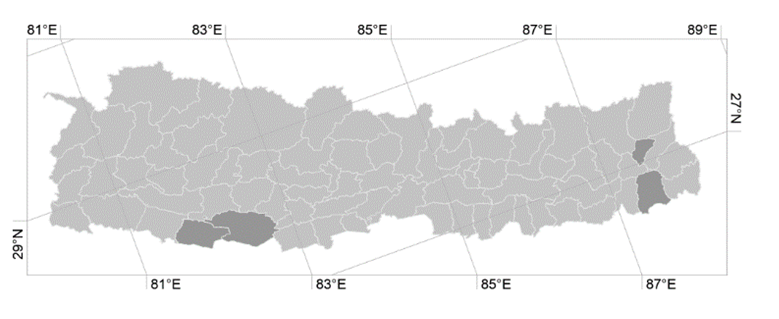
Altitudinal range: 100–1400 m.
Ecology: Ponds, paddy fields and occasionally in temporary ditches.
Flowering: May–September. Fruiting: June–November.
Leaves and young shoots used as vegetables. The whole plant has medicinal values.
*Note: The description of the flowers adapted from the Flora of China and Flora of Thailand.