
Smilax L., Sp. Pl. 2: 1028 (1753)
Heterosmilax Kunth.
Taxon Description
Perennial climbing or erect shrubs. Rhizomes tuberous or stoloniferous. Stems terete, sometimes angular, smooth or rough, woody or herbaceous, with or without prickles. Branches straight or zigzag, with or without prickles. Petioles winged in basal part, wings free or clasping the stem, in climbing shrubs tendrils emerging from apex of wings. Leaves simple, alternate, variable in shape and size, costae 5 or 7, trinerved or triplinerved, veins net like between prominent main veins, often slightly shiny on upper surface and pale on lower surface. Inflorescence umbellate, stalked or sessile, umbels solitary or more than one, peduncle sometimes with a scale like prophyll at base, pedicels arising from flat to globular ‘receptacle’, bracts ovate to triangular to linear, bracteoles present, sometimes absent. Flowers small, unisexual, perianth 6, arranged in 2 whorls of 3 each, varying in color. Staminate flowers: inner and outer tepals differing in shape and size, stamens 6, rarely 3, filaments connate or free at base, anthers white to creamish white, varying in shape and size. Pistillate flowers: staminodes 2–6, stigmas mostly 3, rarely 2, ovary 3-loculed, ovoid to ellipsoid, 1 or 2 ovules per locule. Fruit a fleshy berry, green when young, red, purple to black at maturity. Seeds dark brown, 1—3,.
Taxon Statistics
Worldwide a single genus and about 260 species throughout tropical to temperate regions. One genus and 16 species in Nepal.
Key to Species
1 a Erect shrubs without tendrils …………………………………………………………………………………………………………………………………………………………………………………………………………… 2
b Climbing shrubs with tendrils …………………………………………………………………………………………………………………………………………………………………………………………………….. 3
2 a Stem and branches without prickles. Petioles 5–8 mm. Staminate flowers purplish green. Staminodes 2. Stigmas 3 …………………………..……..…….. 7. S. minutiflora
b Stem and branches with straight long prickles. Leaves sessile to subsessile. Staminate flowers yellowish green. Staminodes 6. Stigmas 2 ……………… 8. S. munita
3 a Inflorescence a sessile umbel. Petioles and leaf margins sparsely prickled ……………………………………………………………………………………………………………….. 1. S. aspera
b Inflorescence a pedunculate umbel. Petioles and leaf margins without prickles ………………………………………………………………………………………………………………………… 4
4 a Inflorescence with more than 1 umbel ………………………………………………………………………………………………………………………………………………………………………………………. 5
b Inflorescence a solitary umbel …………………………………………………………………………………………………………………………………………………………………………………………………. 11
5 a Stem densely rough and warty. Berries black at maturity ……………………………………………………………………………………………………………………………….. 9. S. odoratissima
b Stem smooth. Berries red at maturity ………………………………………………………………………………………………………………………………………………………………………………………… 6
6 a Inflorescence with more than 5 umbels …………………………………………………………………………………………………………………………………………………………………………………….. 7
b Inflorescence with 1–3 umbels …………………………………………………………………………………………………………………………………………………………………………………………………… 8
7 a Petiole wing oblong to half-ovate, 0.5–1 cm wide. Leaf apex obtuse to cuspidate ………………………………………………………………………………………………… 13. S. prolifera
b Petiole wing broadly ovate, more than 1 cm wide. Leaf apex acuminate ……………………………………………………………………………………………………………. 12. S. perfoliata
8 a Anthers lanceolate, filaments connate at base. Ovary globose ……………………………………………………………………………………………………………………………… 14. S. wallichii
b Anthers linear to oblong, filaments free from base. Ovary ellipsoid or ovoid …………………………………………………………………………………………………………………………….. 9
9 a Branches zigzag. Leaf bases deeply cordate ……………………………………………………………………………………………………………………………………………………………. 15. S. wightii
b Branches straight, rarely zigzag. Leaf bases cuneate or truncate ……………………………………………………………………………………………………………………………………………… 10
10 a Leaves elliptic or lanceolate to almost linear, apex acuminate. Receptacle oblong …………………………………………………………………………………………………….. 4. S. ferox
b Leaves broadly ovate to orbicular, apex contracted to cuspidate. Receptacle globose ………………………………………………………………………………………. 11. S. ovalifolia
11 a Peduncle shorter than pedicels. Receptacles reniform ………………………………………………………………………………………………………………………………………. 5. S. lanceifolia
b Peduncle longer than pedicels. Receptacles flat to globose or subglobose …………………………………………………………………………………………………………………………….. 12
12 a Stem angular. Staminate tepals connate. Stamens 3, filaments flattened …………………………………………………………………………………………………………………. 2. S. bockii
b Stem terete to subterete. Staminate tepals free. Stamens 6, filaments filiform ……………………………………………………………………………………………………………………… 13
13 a Petiole wings inversely hastate. Anthers oblong ……………………………………………………………………………………………………………………………………………… 10. S. orthoptera
b Petiole wings oblong to narrow. Anthers linear, lanceolate to oval ………………………………………………………………………………………………………………………………………… 14
14 a Stem densely branched. Berries bluish black at maturity ……………………………………………………………………………………………………………………………………….. 3. S. elegans
b Stem distantly branched. Berries dark purple or red at maturity ……………………………………………………………………………………………………………………………………………. 15
15 a Petiole wings non-clasping the stem. Prophylls absent. Staminate flowers reddish purple ………………………………………………………………..……. 6. S. menispermoidea
b Petiole wings clasping the stem. Prophylls present. Staminate flowers greenish yellow …………………………………………………………………………………….. 16. S. zeylanica
1. Smilax aspera L., Sp. Pl. 2: 1028 (1753).
Smilax capitata Buch.-Ham. ex D.Don; S. fulgens Wall.; S. maculata Roxb. ex D.Don.
चोप चिनी Chopchini, कुकुर डाइनो Kukur daino (Nepali).
Large climbing shrubs. Stems ridged, angular and prickly, distantly branched. Branches zigzag, with straight or recurved prickles. Petioles 1–1.5 cm, unwinged portion longer, wings triangular, 1–1.5 mm wide, non-clasping, sparsely prickled tendrils 3–8 cm long. Leaves triangular-hastate, sometimes ovate-lanceolate, 4–9(–13) x 1.2–7(–9) cm, base deeply cordate, sometimes truncate with rounded basal lobes, apex acute, margin prickled, costae 5 or 7, triplinerved. Inflorescence sessile, umbels 6–12, arranged in a raceme, prophylls ovate, receptacle globular, bracts caducous, bracteoles small, 1–2 mm, pedicels 2–5 mm long, male umbels 15–20-flowered, female 10–15-flowered. Staminate flowers: perianth whorls dimorphic, yellowish green, tepals linear, outer tepals ca. 1.6 x 1 mm, inner tepals ca. 4 x 1 mm, stamens 6, filaments filiform, free, 1–2 mm, anthers white, lanceolate, ca. 1 mm. Pistillate flowers: female flowers smaller than male, staminodes 6, ovary ellipsoid, stigma 3. Berries red at maturity, globose, 5–7 mm in diam. Seeds 1–3.
Distribution: Nepal, W Himalaya, E Himalaya, Tibetan Plateau, Assam-Burma, S Asia, E Asia, SW Asia, Europe and Africa.
Altitudinal range: 400–3,000 m.
Ecology: Temperate broad-leaved evergreen forests, open shrub lands and edge of cultivated lands.
Flowering: September–November.
Fruiting: May–August.
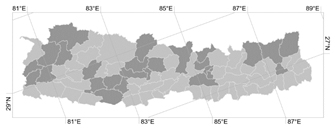
Smilax aspera is the most commonly occurring species of Smilax in Nepal. It can be easily recognized by its triangular to hastate leaves, prickly leaf margin and petioles, and inflorescence with sessile umbels. Known for its medicinal properties such as stem and leaf extract are used for curing maternity problems, dysentery, scabies and skin diseases, ripe fruits applied to cure scabies. Young shoots are consumed as vegetables and flowers are used to make pickles.
2. Smilax bockii Warb. ex Diels, Bot. Jahrb. Syst. 29(2): 259 (1900).
Heterosmilax indica A.DC.; H. japonica Kunth.
Climbing shrubs. Stems angular or terete, smooth, without prickles, distantly branched. Branches slightly zigzag, angular or straight. Petioles 3–5 cm, wings 0.5–1 mm wide, non-clasping tendrils 3–7 cm long. Leaves ovate-lanceolate to ovate-oblong, 17–20 × 8–9.5 cm, base obtuse to cordate, apex acuminate, costae 5 or 7, triplinerved. Inflorescence a solitary umbel, prophylls absent, peduncle 3–5 cm, receptacle flat to globular, bracts caducous, bracteoles ovate to lanceolate, ca. 2 mm, pedicels unequal, 1–2 cm, male umbels 20–30-flowered, female 10–20-flowered. Staminate flowers: perianth whorls equal, yellowish green, tepals connate, 3–5 x 1–3 mm, tapering at base, forming 3-teeth at apex, stamens 3, filaments flattened, connate at base, 2–2.5 mm, anthers oblong, 0.5–1 mm, creamish white. Pistillate flowers: staminodes 3, ovary globose, stigma 3. Berries black at maturity, globose, 6–8 mm in diam. Seeds 1–3.
Distribution: Nepal, E Himalaya, Assam-Burma, E Asia and SE Asia.
Altitudinal range: 100–200 m.
Ecology: Tropical forests. Often associated with rivers.
Flowering: June–August.
Fruiting: August–February.
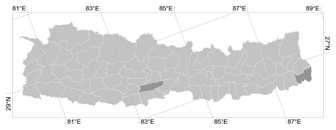
Smilax bockii was previously known as Heterosmilax japonica which is synonymized under this species. Angular stems without prickles, inflorescence with solitary umbel, connate tepals and yellowish green flowers with three stamens are distinctive characters of S. bocki.
3. Smilax elegans Wall. ex Kunth, Enum. Pl. [Kunth] 5: 163 (1850).
Smilax elegans subsp. elegans; S. elegans subsp. glaucophylla (Klotzsch) Noltie; S. glaucophylla Klotzsch; S. longibracteolata Hook. f.; S. parvifolia Wall. ex Hook. f.
Climbing shrubs. Stems terete, without prickles, main stem always straight, lateral stem zigzag, densely branched. Branches straight or zigzag, flowering branches always zigzag. Petiole 0.3–1.5cm, winged, wings 1–2 mm wide, non-clasping, tendrils vestigial on flowering branches, persistent on non-flowering branches, ca. 1 cm long. Leaves ovate to lanceolate, 4–8 x 2–4 cm, base cordate in ovate leaves, truncate in lanceolate, apex acuminate to deltoid, costae 5 or 7, triplinerved. Inflorescence a solitary umbel, prophylls absent, peduncle 1–1.5 cm, bracts caducous, bracteoles lanceolate, ca. 1 mm, pedicels shorter than peduncle, receptacle globose, male umbels 10–15-flowered, female 5–10-flowered. Staminate flowers: perianth whorls dimorphic, greenish yellow outer tepals oblong-lanceolate, 1.5–2 x ca. 1 mm, inner tepals narrow, stamens 6, filaments free, ca. 1 mm long, anthers linear, ca. 0.5 mm, white. Pistillate flowers: elliptic, ca. 2.5 x 1 mm, staminodes 3, ovary oval, stigmas 3. Berries black when ripe, globose, ca. 3 mm in diam. Seeds 1 or 2.
Distribution: Nepal, W Himalaya, E Himalaya, Tibetan Plateau, Assam-Burma.
Altitudinal range: 1,600–3,100 m.
Ecology: Subtropical evergreen forests and disturbed forests.
Flowering: April–June.
Fruiting: August–October. 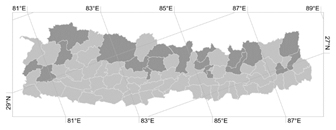
Smilax elegans closely resembles with Smilax menispermoidea in having ovate leaves and absence of prickles, however, it differs by its zigzag branches, greenish yellow staminate flowers and black berries.
4. Smilax ferox Wall. ex Kunth, Enum. Pl. [Kunth] 5: 251 (1850).
चटलाङ्ग Chatlang (Nepali).
Climbing shrubs. Stems terete, prickly, densely branched. Branches straight, angular when young, with straight or recurved prickles. Petioles 1–5 mm, wings 1–3 mm wide, triangular, non-clasping, tendrils vestigial in flowering branches, present in non-flowering shoots, 5–11 cm long. Leaves elliptic, lanceolate to almost linear, 3.5–9.6 (–14) x 1.3–4 (–6) cm, base obtuse to truncate, apex acuminate, costae 5, trinerved. Inflorescence a solitary umbel, prophylls absent, peduncle 0.9–2 cm long, receptacle oblong, pedicels 0.5–1 cm, bracts caducous, bracteoles lanceolate, 2—3 mm, male umbels 15–25-flowered, female 10–15-flowered. Staminate flowers: perianth whorls dimorphic, greenish yellow, outer whorl lanceolate, ca. 5 x 2 mm, inner whorl linear ca. 5 x 1 mm, stamens 6, 3–3.5 mm, filaments free, 1– 2 mm long, anthers white, oblong, ca. 0.5 mm. Pistillate flowers: outer whorl oblanceolate ca. 3 x 1.5 mm, inner whorl lanceolate ca. 3 x 1 mm, staminodes 3, ovary ovoid, stigmas 3. Berries orange red at maturity, globose, 6–10 mm in diam. Seeds 1–3.
Distribution: Nepal, E Himalaya, Assam-Burma, S Asia, E Asia and SE Asia.
Elevation ranges: 1,100-2,700 m.
Ecology: Degraded subtropical broad leaved forests, dry rocky places and cultivated lands.
Flowering: April–May
Fruiting: September–November.
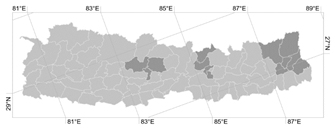
5. Smilax lanceifolia Roxb., Fl. Ind. ed. 1832 (Roxburgh) 3: 792 (1832).
कुबिरैनो Kubiraino, चोप चिनी Chop chini (Nepali).
Climbing shrubs. Stems terete, smooth, without prickles or sparsely prickled, distantly branched. Branches terete or obscurely angular and smooth. Petioles 10–15 mm, wings 2–3 mm wide. non-clasping tendrils rudimentary in flowering branches, persistent in non-flowering branch, 5–10 cm long. Leaves broadly ovate to ovate-lanceolate, 5–16 x 2–8 cm, base obtuse, apex acuminate, costae 5, trinerved. Inflorescence a solitary umbel, prophylls ovate, peduncle ca. 1 cm, receptacle reniform, bracts single almost triangular, ca. 3 mm, bracteoles small, less than 1 mm, pedicels capillary to filiform, 1–1.5 cm, peduncle shorter than pedicels, male umbels 15–20-flowered, female 10–15-flowered. Staminate flowers: perianth whorls dimorphic, light green, outer whorl lanceolate, 5–6 x 1.5–2 mm, inner whorl linear, ca. 5 x 1 mm, stamens 6, 5–6 mm, filaments filiform, 2–3 mm, free, anthers white, ca. 1 mm. Pistillate flowers: outer tepal almost triangular, ca. 2.5 x 1 mm, inner almost linear, ca. 2.5 × 0.5 mm, staminodes 3, ovary oval stigmas 2 or 3. Berries dark green, globose, ca. 2 mm in diam. Seeds 1–2.
Distribution: Nepal, E Himalaya, Assam-Burma, S Asia, E Asia and SE Asia.
Elevation ranges: 1,500–2,200 m.
Ecology: Mixed forests.
Flowering: October–December.
Fruiting: February–April.
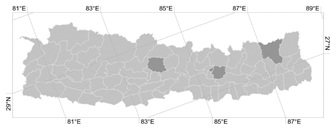
6. Smilax menispermoidea A.DC., Monogr. Phan. [A.DC. & C.DC.] 1: 108 (1878).
Smilax luteocaulis H.Lev.; S. rubriflora Rehder.
हाडे कुकुरडाइनु, Hade kukurdainu (Nepali).
Scandent climbing shrubs. Stems terete, smooth, without prickles, distantly branched. Flowering branches terete and striate, sometimes slightly zigzag. Petioles 5–14 mm, wings ca. 1–2 mm wide, non-clasping, tendrils 3–12 cm long. Leaves ovate or broadly ovate, 3–7 X 1.3–3 cm, base truncate or shallowly cordate, apex acute to acuminate, costae 5 or 7, triplinerved. Inflorescence a solitary umbel, prophylls absent, peduncle 2–6 cm, receptacle thin, bracts caducous, bracteoles small, 1.5—2 mm, pedicel filiform to capillary, 0.5–1 cm long, male umbels 15–25-flowered, female 10–15-flowered. Staminate flowers: perianth whorls equal, reddish purple, tepals ovate, ca. 3.5 x 1.5 mm, stamens 6, 0.6–1 mm, filaments free, ca. 0.5 mm long, anthers yellowish white, oval, ca. 0.5 x 0.5 mm. Pistillate flowers: outer tepals ovate, ca. 3.5 x 1.5 mm, inner tepals oblanceolate, ca. 3.5 x 1 mm, staminodes 1–3, ovary globose, stigmas 3. Berries dark purple at maturity, globose, 6–8mm in diam. Seed 1–3.
Distribution: Nepal, W Himalaya, E Himalaya, Tiibetan Plateau, Assam-Burma, E Asia and SE Asia.
Elevation ranges: 1,700–4,000 m.
Ecology: Semi-evergreen forests, Abies forests, semi-deciduous broad-leaved forests and shady places.
Flowering: May–July.
Fruiting: October–December.
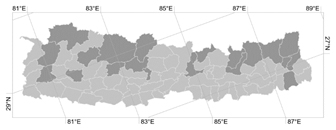
7. Smilax minutiflora A.DC., Monogr. Phan. [A.DC. & C.DC.] 1: 109 (1878).
Erect shrubs to 1 m. Stems terete or angular, without prickles, densely branched. Branches straight or slightly zigzag. Petioles 3–8 mm, wings ca. 0.5 mm wide, non-clasping tendrils absent. Leaves lanceolate to ovate-lanceolate, 3–14 x 1–5.5 cm, base obtuse or truncate, apex acuminate or caudate, costae 5, trinerved. Inflorescence a solitary umbel, prophylls absent, receptacle globular, pedicel 0.7–1 cm, peduncle 1.3–2.5 cm, bracts ovate, 3–4 mm, bracteoles rarely present, lanceolate, ca. 3 mm, male umbels 3–5-flowered, female 2–4-flowered. Staminate flowers: perianth whorls dimorphic, purple, outer tepals ovate, ca. 2 x 1.5 mm, inner tepals lanceolate, ca. 1 x 1 mm, stamens 6, inserted, 1.5 mm, filaments connate at base, ca. 0.5 mm long, anthers white, globose, ca. 0.4 mm. Pistillate flowers larger than staminate flowers, purplish green, outer ovate ca. 3.5 x 1.5 mm, inner almost ovate ca. 3.5 x 1.25 mm, staminodes 2, ovary globose, stigmas 3. Berries black at maturity, globose, 5–7 mm in diam. Seeds 1–3.
Distribution: Nepal, E. Himalaya, Assam-Burma and S Asia.
Elevation ranges: 1,600–4,000 m.
Ecology: Temperate broad-leaved forests.
Flowering: May–July.
Fruiting: August–December.
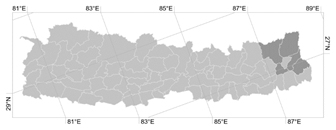 Smilax minutiflora can be distinguished by its erect habit, densely branched, lanceolate to ovate-lanceolate leaves and small purplish green flowers.
8. Smilax munita S.C.Chen, Acta Phytotax. Sin. 34(4): 436 (1996).
Smilax myrtillus var. rigida Noltie; S. rigida Wall. ex Kunth.
Erect shrubs, 40 cm to 1.5 m. Stems quadrangular or terete, with long, straight prickles, densely branched. Branches straight, angular and prickly. Petiole 0.5–1 mm, upper petiole less than 0.5 mm, wings 1.5–4 mm wide, triangular, non-clasping tendrils absent. Leaves mostly ovate, sometimes elliptic and lanceolate 1.3–2.8 x 0.8–2.6 cm, base truncate, sometimes slightly cordate, apex notched outwards, acuminate, costae 5, trinerved. Inflorescence a solitary umbel, prophylls absent, receptacle reniform, peduncle 3–7 mm, bracts ovate, ca. 2 mm long, bracteoles lanceolate, ca. 2.5 mm long, pedicel 1.5–3 mm, male umbels 3–6-flowered, female 2–4-flowered. Staminate flowers: perianth whorls equal, yellowish green, almost elliptic, ca. 3 x 1.5 mm, stamen 6, equal in length, filament ca. 1.5 mm, connate at base, anthers white, globose, less than 0.5 mm. Pistillate flowers: tepals ovate-elliptic, ca. 2 x 1–1.5 mm, staminodes 6, ovary globose, stigmas 2. Berries orange red at maturity, globose, 0.5–1 mm diam. Seeds 1 or 2.
Distribution: Nepal, E Himalaya, Tibetan Plateau, Assam Burma and E Asia.
Altitudinal range: 1,800–3,000 m.
Ecology: Temperate broad-leaved forests and disturbed forests.
Flowering: March–July.
Fruiting: October–November.
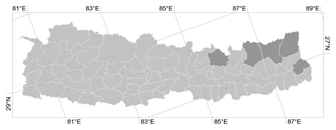
Smilax munita is characterized by its dense branching, ovate leaves with sessile to sub-sessile petiole and long straight prickles in stem and branches. It shows close resemblance with S. myrtillus (a doubtful species in Nepal) and is mostly misidentified due to its similarities in being erect shrub and its sessile to subsessile leaves but differs in consisting long prickles which is absent in S. myrtillus.
9. Smilax odoratissima Blume, Enum. Pl. Javae 1: 19 (1827).
Smilax aspericaulis Wall. ex A.DC.; S. bracteata var. verruculosa (Merr.) T.Koyama; S. verruculosa Merr.
Climbing shrubs. Stems subterete to angular, rough and warty, with straight or recurved prickles, distantly branched. Branches slightly zigzag, subterete to angular, warty and prickly. Petioles 1–2 cm, wings oblong, 1–2 mm wide,non-clasping tendrils 8–15 cm long. Leaves lanceolate-elliptic to ovate-elliptic, 4–16 x 3–9 cm, rounded at base, apex acuminate, costae 5, trinerved. Inflorescence umbellate, with 1–3 umbels, prophylls ovate, peduncles 1.5–2 cm, receptacles globose, bracts caducous, bracteoles absent, pedicels red, 1–1.5 cm, male umbels 25–30-flowered, female 15–25-flowered. Staminate flowers: perianth whorls dimorphic, pale yellow, outer tepals oblong to lanceolate 4–5 x 1–1.5 mm, inner tepals linear, stamens 6, filaments ca. 3–5 mm long, free, anthers white, linear to oblong, ca. 1 mm. Pistillate flowers: outer tepals ovate-lanceolate, obtuse at apex, inner linear and narrow, staminodes 3, ovary ovoid, stigma 3. Berries purplish black at maturity, ovoid to globose, 4–6 mm in diam. Seeds 1–3.
Distribution: Nepal, E Himalaya, Assam-Burma, E Asia and SE Asia.
Elevation ranges: 2,000–2,200 m.
Ecology: Subtropical to temperate forests. On south facing slope.
Flowering: October–November.
Fruiting: December–February.
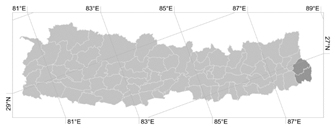
Smilax aspericaulis is considered as a synonym of Smilax odoratissima due to its similarity in morphological characters such as warty stem, leaf characters, inflorescence 1-3 and floral characters. Several authors have considered both as distinct species. Further molecular study is required for its identity.
10. Smilax orthoptera A.DC., Monogr. Phan. [A.DC. & C.DC.] 1: 192 (1878).
Climbing shrubs. Stems terete to subterete, with straight, conical prickles, distantly branched. Branches slightly zigzag, sparsely prickled. Petioles 1–3 cm, wings 5–7 mm wide, inversely hastate, non-clasping tendrils 5–15 cm long. Leaves ovate-lanceolate to ovate-oblong, 10–25 x 5–15 cm, base cuneate to rounded, apex acute to acuminate or caudate, costae 5, trinerved. Inflorescence umbellate, with 1–3 umbels, prophylls ovate, peduncles 2–6 cm, receptacles flat to subglobose, bracts ovate, 2–4 mm, bracteoles caducous, pedicels filiform to capillary, 1.5–2 cm, male umbels 30–50-flowered, female 20–40-flowered. Staminate flowers: perianth whorls dimorphic, yellowish green, outer tepals oblong to lanceolate, 3–6 x 1–2 mm, inner tepals linear, stamens 6, 7–10 mm, filaments filiform, free, 8–10 mm long, anthers creamish white, oblong, 0.5–1 mm. Pistillate flowers: perianth pinkish-green, outer tepals ovate to oblong, 3–4 x 0.5–1 mm, inner tepals linear, staminodes 3, ovary ovoid, stigmas 3. Berries black at maturity, ovoid to globose,5–7 mm in diam. Seed 1–3.
Distribution: Nepal, E. Himalaya and Assam-Burma.
Elevation ranges: 100–1,500 m.
Ecology: Tropical to subtropical broad leaved forests and slopes.
Flowering: February–May.
Fruiting: May–August.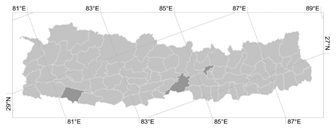
11. Smilax ovalifolia Roxb. ex D.Don, Prodr. Fl. Nepal: 49 (1825).
Smilax columnifera Buch.-Ham. ex D. Don; S. macrophylla Roxb.; S. retusa Roxb.; S. roxburghii Kunth.
Climbing shrubs. Stems terete or slightly rigid, sparsely prickly, distantly branched. Branches sometimes zigzag, prickles hooked downwards. Petiole 0.5–2 cm, wings 0.5–1 mm wide, triangular, non-clasping tendrils 8–9 cm long. Leaves broadly ovate to oribicular, 7–21 x 2.9–15 cm, base cuneate or truncate, apex contracted to cuspidate, costae 5 or 7, triplinerved. Inflorescence umbellate, with 1–3 umbels, prophylls ovate, peduncles 1.5–3 cm longer than pedicels, receptacles globose, bracts triangular, ca. 3 mm, bracteoles lanceolate, ca. 1.5 mm, male umbels 15–25-flowered, female 12–15-flowered. Staminate flowers: perianth whorls dimorphic, green, outer whorl lanceolate, ca. 7.5 x 2 mm, inner linear ca. 7.5 x 1 mm, recurved when blooming, stamens 6, filaments 4–6 mm long, free, anthers white, linear, ca. 2 mm. Pistillate flowers: smaller than male flower, outer tepals oblong, 4–6 x 1–1.5 mm, inner tepals linear, staminodes 3, ovary ovoid, stigma 3. Berries red at maturity, globose, ca. 1.5 cm in diam. Seeds 1 or 2.
Distribution: Nepal, W Himalaya, E Himalaya, Assam-Burma, S Asia, E Asia and SE Asia.
Elevation ranges: 100–2,200 m.
Ecology: Tropical to subtropical Schima-Castonopsis forests and shady gullies.
Flowering: March–May.
Fruiting: December–January.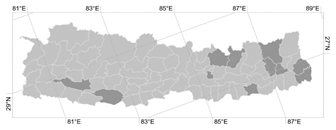 Smilax ovalifolia is easily recognized by its stem and branches with prickles hooked downwards, broadly ovate to oribicular leaves, non-clasping petiolar wings and greenish flowers. Young shoots of this species are consumed as vegetables.
12. Smilax perfoliata Lour., Fl. Cochinch. 2: 622 (1790).
Smilax laurifolia auct. non Willd.; S. laurina Kunth.
Robust climbing shrubs. Stems terete, with curved, conical prickles, distantly branched. Branches straight or zigzag, sparsely prickly. Petioles 1.5–5 cm, wings broadly ovate, 1–1.5 cm wide, clasping. tendrils 5–14 cm long. Leaves ovate to obovate or elliptic, 7–21 x 3.2–14 cm, base obtuse or truncate, apex acuminate, costae 5 or 7, tripliverved. Inflorescence branched with 7–15 umbels, prophyll ovate, peduncles 1.5–3.5 cm, receptacles globose, bracts linear, ca. 3 mm, bracteoles caducous, pedicels 0.5–1.1 cm, male umbels 20–30-flowered, female 15–25-flowered. Staminate flowers: perianth whorls dimorphic, yellowish green, outer tepals lanceolate ca. 5.5 x 2 mm and inner tepals linear ca. 5.5 x 1 mm, stamens 6, all equal in size, 6–6.5 mm, filaments free, 4–5 mm long, anthers creamish white, linear, ca. 1 mm. Pistillate flowers: perianth green, outer tepals ovate-oblong to ovate-lanceolate, 4–5 x 1–1.2 mm, inner tepals narrow, staminodes 3, ovary ellipsoid, stigmas 3. Berries red at maturity, globose, green, ca. 1 cm diam. Seeds 1 or 2.
Distribution: Nepal, W Himalaya, E Himalaya, Assam-Burma, S Asia, E Asia and SE Asia.
Elevation ranges: 100–3,000 m.
Ecology: Shrub lands and disturbed forests.
Flowering: March–May.
Fruiting: August–October.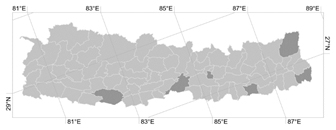
Smilax perfoliata closely resembles with S. wallichii in its leaf and stem characters. But differs from S. wallichii in having larger petiole wings that is clasping the stem.
13. Smilax prolifera Roxb., Fl. Ind. ed. 1832 (Roxburgh) 3: 795 (1832).
Smilax siamensis T.Koyama.
Large climbing shrubs. Stems terete or angular, smooth, furrowed when young, recurved prickles, distantly branched. Branches weakly zigzag, sparsely prickly. Petiole 1–5 cm, wings half ovate, 5–10 mm wide, brown papery, clasping. tendrils 5–15 cm long. Leaves oblong-ovate, 13.5–17 × 7–11 cm, base obtuse to truncate, apex obtuse, sometimes shortly cuspidate, costae 7, triplinerved. Inflorescence umbellate with 6–12 umbels, prophylls ovate, peduncles 2–4 cm, receptacles globular, bracts linear, 2–3 mm, bracteoles caducous, pedicels ca. 1 cm, male umbels 20–30-flowered, female 13–30-flowered. Staminate flowers: perianth whorls dimorphic, greenish yellow, outer lanceolate ca. 6 x 1 mm, inner linear ca. 7 x 0.5 mm, stamens 6, filaments thread-like, free, ca. 8 mm long, anthers creamish white linear, ca. 1.5 mm. Pistillate flowers: smaller than male, outer tepals ovate, ca. 5 x 2 mm, inner almost lanceolate, ca. 5 x 1 mm, staminodes 3, stigmas 3. Berry red at maturity, globose, 5–10 mm in diam. Seeds 1–3.
Distribution: Nepal, E Himalaya, S Asia, Assam-Burma and SE Asia.
Elevation ranges: 300–1,500 m.
Ecology: Open woodland and riverbanks, above Churiya hills and disturbed forests.
Flowering: February–April.
Fruiting: August–October.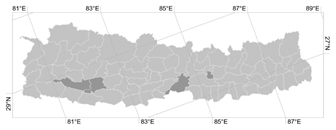 Smilax prolifera closely resembles S. perfoliata but can be differentiated by its oblongovate leaves, usually blunt, exerted apex, number of costae and larger petiolar wings. S. prolifera has been regarded as conspecific with S. perfoliata by many authors but few others as well as molecular studies have considered both as a distinct species.
14. Smilax wallichii Kunth, Enum. Pl. [Kunth] 5: 246 (1850).
Large climbing shrubs. Stems terete, stout, prickly and distantly branched. Branches terete, striate and with sparse, straight or recurved prickles. Petiole 1–3 cm, wings narrow, triangular, 0.5–1 cm wide, non-clasping. tendrils 5–7 cm long. Leaves oblanceolate to lanceolate, 12–16 × 5–7.5 cm, base truncate, apex acuminate, costae 5 or 7, triplinerved. Inflorescence branched, with 1–3 umbels, if solitary one or more rudimentary umbels always present, prophylls triangular, 7 x 7 mm, apex acuminate, peduncles 1.5–2 cm, longer than pedicels ca. 0.7 cm, receptacles reniform, bracts almost triangular, 4–5 mm, bracteoles caducous, male umbels 25–40-flowered, female 15–25-flowered. Staminate flowers: flowers bell-shaped, perianth whorls dimorphic, green, outer whorl lanceolate 9 x 3 mm, inner linear, ca. 9 x 1 mm, stamens 6, 5–9 mm, filaments free, 6–8 mm long, anthers white, lanceolate, 1–1.5 mm. Pistillate flowers: smaller than male, light green, outer tepals lanceolate, ca. 5.5 x 2.5 mm, inner tepals linear, ca. 5 x 1 mm, staminodes 3, linear, ovary globose, stigmas 3 Berries red at maturity, globose, 4–5 mm in diam. Seeds 1–3.
Distribution: Nepal and E Himalaya.
Elevation ranges: 1,300–2,600 m.
Ecology: Disturbed forests.
Flowering: February–April.
Fruiting: July–October. 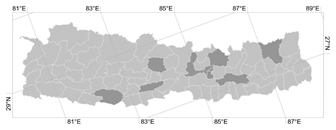
Smilax wallichii is regarded as uncertain species by many authors due to its close resemblance with S. ocreata (a doubtful species in Nepal) in its leaf characters. It differs from S. ocreata in having non-clasping petiolar wings and light green pistillate flowers. As it is an accepted name and collected specimens from different locations of Nepal confirms the presence of S. wallichii in Nepal.
15. Smilax wightii A.DC., Monogr. Phan. [A.DC. & C.DC.] 1 (1878).
Coarse climbing shrubs. Stems terete and prickly, distantly branched. Branches zigzag, with sparse, short, recurved prickles. Petioles 1–3 cm, wings 1–1.5 mm wide, non-clasping, tendril 3–12 cm long. Leaves broadly elliptic, 10–18 x 11–20 cm, sometimes lanceolate 4–7 x 2–3 cm, base deeply cordate, apex notched outwards, costae 5 or 7, triplinerved. Inflorescence branched, with 2 or 3 umbels, inflorescence axis zigzag, prophylls triangular, peduncles 2–3 cm, longer than pedicels 1–1.5 cm, receptacles reniform, bracts triangular, 2–5 mm, bracteoles caducous, male umbels 20–30-flowered, female 10–18-flowered. Staminate flowers: perianth whorls dimorphic, creamish white, outer whorl narrowly lanceolate ca. 7 x 2 mm, inner whorl linear, ca. 7 x 1 mm, stamens 6, 7–7.5 mm, filaments filliform, 7–9 mm long, free, anthers white, linear ca. 1.5 mm. Pistillate flowers: perianth light green, outer tepals linear, ca. 5 x 1 mm, inner tepals lanceolate ca. 5.5 x 2 mm, staminodes 3, ovary ellipsoid, stigmas 3. Berries red at maturity, globose, ca. 5 mm in diam. Seeds 1–3.
Distribution: Nepal, E Himalaya, and S Asia.
Elevation ranges: 200–1,600m.
Ecology: Subtropical evergreen forests and disturbed forests.
Flowering: February–April.
Fruiting: June–August.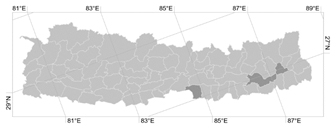
16. Smilax zeylanica L., Sp. Pl. 2: 1029 (1753).
Smilax elliptica Desv. ex Ham.; S. indica Burm.f.
Climbing shrubs. Stem angular, with straight conical prickles, distantly branched. Branches zigzag, angular to subterete, prickly. Petioles 0.5–2 cm, curved below the middle, wings 0.5–1 mm wide, clasping. tendrils 5–10 cm long. Leaves broadly elliptic to ovate-oblong, 4–10 x 2–7 cm, base rounded to truncate, apex subacute, costae 5, trinerved. Inflorescence umbellate, with 1–3 umbels, prophylls ovate, peduncles 1–2 cm, receptacles globose, bracts caducous, bracteoles small, ca. 1 mm, pedicels 1–1.5 cm long, male umbels 10–30-flowered, female 20–40-flowered. Staminate flowers: perianth whorls dimorphic, greenish white, outer tepals oblong to lanceolate, 4–5 x 0.5–1 mm, inner tepals linear, stamens 6, 4–6 mm, filaments filiform, free, ca. 4 mm long, anthers white, lanceolate, 0.5–1 mm. Pistillate flowers: smaller than male flowers, staminodes 3 or 6, ovary globose, stigmas 3. Berries red at maturity, globose, 4–6 mm in diam. Seeds 2 or 3.
Distribution: Nepal, E Himalaya, Assam-Burma, S Asia and SE Asia.
Elevation ranges: 100–1,500 m.
Ecology: Tropical to subtropical forests and disturbed forests.
Flowering: May–October.
Fruiting: October–March. 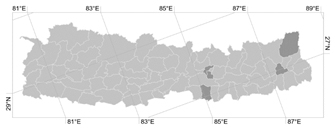
Smilax aspericaulis Wall. ex A. DC., A.L.P.P.de Candolle & A.C.P.de Candolle, Monogr. Phan. 1: 195 (1878).
Eastern Nepal: Koshi Province, Ilam, Hangetham – Gairibas, 2172 m, 07/06/2007, B. Adhikari et al. LKSRB 173 (E E00674049). Det. H. Noltie
Sukhramani et al. (2024) and Plants of the world (www.powo.org) have considered Smilax aspericaulis as a synonym of S. odoratissima. The examination of herbarium specimens collected from Eastern Nepal and deposited at RBGE and KATH also reveals similarities in their morphological traits. Therefore, S. aspericaulis is currently regarded as a synonym of S. odoratissima. However, several authors still recognize S. aspericaulis as a distinct species, indicating that further investigation is needed for its identity.
- Smilax elegans subsp. osmastonii (F.T.Wang & Tang) Noltie, Edinburgh J. Bot. 51: 155 (1994).
Smilax osmastonii F.T.Wang & Tang, Bull. Fan Mem. Inst. Biol., Bot. 7: 298 (1937).
Distribution: ?Nepal, E Himalaya and Assam-Burma.
Central Nepal: Bagmati Province, Kathmandu, Shivapuri, 2700 m, 15/06/1969, H. Ohashi 69996 (TI00123339).
This species is endemic to southern China, but its distribution in Nepal has been reported by Sukhramani et al. (2024). Herbarium specimens collected from Central Nepal are deposited at TI (TI 69996). However, no additional herbarium specimens are available for study in Nepal. Therefore, further investigation is necessary to confirm its presence in Nepal.
- Smilax lanceifolia var. elongata (Warb.) F.T.Wang & Tang, Fl. Reipubl. Popularis Sin. 15: 220 (1978).
Smilax microphylla var. elongata Warb. Bot. Jahrb. Syst. 29: 259 (1900).; Smilax microphylla subsp. elongata (Warb.) T. Koyama
Central Nepal: Gandaki Province, Kaski, Panchase forest, Bhadaure Tamang VDC, 2306 m, 09/06/2014, P. Bhandari & B.S. Magar P633 (KATH074446). Bagmati Province, Lalitpur, Phulchoki, S. of Kathmandu, 2200-2700 m, 28/05/1972, H. Ohashi & H. Ohba 724010 (00123335).
This species is endemic to Southeast Asia, but Sukhramani et al. (2024) reported its distribution in Nepal, with herbarium specimens collected from Central Nepal deposited at TI. However, no herbarium specimens are available for study in Nepal. Therefore, further investigation is required to confirm its occurrence in Nepal.
- Smilax myrtillus A. DC., A.L.P.P.de Candolle & A.C.P.de Candolle, Monogr. Phan. 1: 106 (1878).
Smilax rigida subsp. myrtillus (A.DC.) T.Koyama
Distribution: Nepal, E. Himalaya, Tibetan Plateau, Assam-Burma and S Asia, E Asia and SE Asia.
Although Smilax myrtillus is an accepted name, several herbarium specimens collected from Nepal are deposited in different herbara worldwide. However, most of the specimens mentioned as S. myrtillus have been determined as S. munita, and the remaining specimens are also doubtful. Therefore, further investigation is needed to verify the presence of this species in Nepal.
- Smilax ocreata A.DC., A.L.P.P.de Candolle & A.C.P.de Candolle, Monogr. Phan. 1: 191 (1878).
Distribution: ?Nepal, E. Himalaya, Tibetan Plateau, Assam-Burma and S Asia, E Asia and SE Asia.
Eastern Nepal: Koshi Province, Panchthar, Tharpu – Chyangthapu, 26/11/1963, H. Hara et al. 6300859 (TI00123331). Taplejung, Khebang – Bharomdin, 24/11/1963, H. Hara et al. 6300859 (TI00123330)
Distribution of this species has been reported, and specimens collected from E. Nepal are deposited at RBGE and TI. However, these specimens have been identified as S. prolifera, and species confirmation could not be made from the available images as well as due to the absence of herbarium specimens at KATH. Therefore, further collection and investigation are required to confirm the presence of this species in Nepal.
- Smilax vaginata Decne., In V.Jacquemont, Voy. Inde 4(Bot.): 169 (1844).
Distribution: ?Nepal, W Himalaya, Assam-Burma and SW Asia.
Central Nepal; Bagmati Province, Dhading, Ankhu Khola, Kal Khadga, above Tibling, 2650 m, 17/07/1992, Baker, Miller & Burkitt 62 (K002376467).
Smilax vaginata is an accepted name. Sukhramani et al. (2024) reported its distribution in Nepal, and a single specimen collected from Central Nepal is deposited at Kew (K). However, no herbarium specimens are available for study in Nepal. The available digital image only shows the vegetative parts, which are insufficient for species confirmation. Therefore, further collection and investigation are needed to confirm its status.