
7. Streptopus Michx., Fl. Bor.-Amer. 1: 200 (1803).
Taxon Description
Perennial herbs, with a creeping rhizome. Stems leafy, erect, simple or branched, branching occurs distally, bearing sheathing leaf bases below. Leaves alternate, simple, sessile, base sometimes amplexicaul, basal lobes clasping stems, ovate to lanceolate, apex acuminate, margin entire, glabrous, veins many, parallel. Inflorescences single-flowered, borne on leaf axils; ebracteate. Flowers bisexual, actinomorphic, campanulate, pendulous; pedicel slender, thin, filiform, or linear, partly adnate to stems, shorter than subtending leaf. Tepals 6, white, free, unequal, inner ones slightly wider than outer. Stamens 6, hypogynous, inserted at base of tepals; filaments usually flattened and broad at base; anthers erect, basifixed. Ovary 3-loculed, ovules 2 or more in number; style columnar, very short, stigma with 3-distinct lobes. Fruit a berry, globose. Seeds many, oblong.
Taxon Statistics
About ten species from temperate regions of the N hemisphere. Two species native to Nepal.
Key to Species
1 a. Stems branched; filaments shorter than anthers…………………………………………………… S. simplex
b. Stems unbranched; filaments equalling anthers……………………………………………1. S. parasimplex
1. Streptopus parasimplex H.Hara & H.Ohashi., J. Jap. Bot. 48: 101 (1973).
Perennial herbs. Plants10–35 cm tall. Rhizomes short and creeping, stolons cream coloured. Stems simple, leafy, usually unbranched, glabrous. Leaves alternate, simple, sessile, lanceolate to ovate-lanceolate, 3–8 × 1.2–2 cm, base cordate or amplexicaul, basal lobes clasping stems, apex acuminate, margin entire, glabrous, veins 3–7, parallel. Inflorescences single-flowered, borne on leaf axils; ebracteate. Flowers bisexual, actinomorphic, campanulate, pendulous; pedicel 1.5–4 cm, thin, slender, shorter than subtending leaf. Tepals white, with fine purple spots at base, oblong to elliptic, unequal, inner slightly broader than outer, outer 1–1.5 × 0.3–0.6 cm, inner 1–1.5 × 0.5–0.1 cm. Stamens inserted at base of tepals; filaments ca. 2 mm, equalling the anthers; anthers ca. 2 mm, lanceolate, with cordate base. Ovary ovovoid, 2 mm; style slender, 3–4 mm, somewhat longer than stigmatic lobes; stigma distinctly 3-lobed, short. Berries globose, ca. 5 cm in diameter. Seeds many, oblong.
Distribution: Nepal, and E Himalaya.
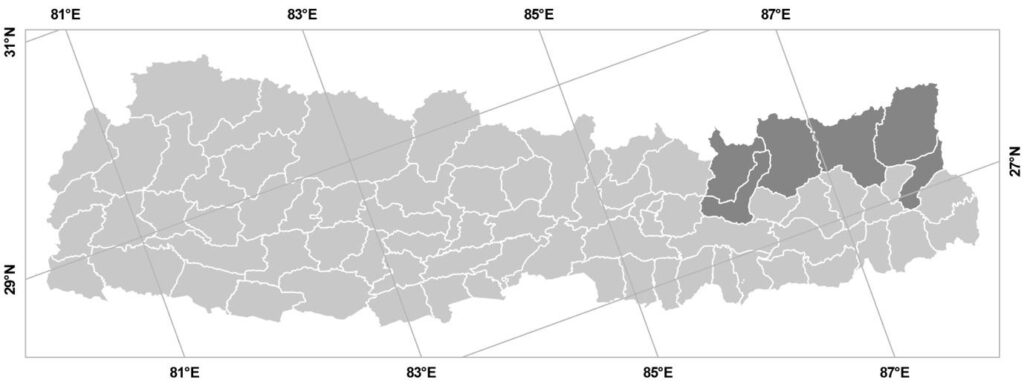
Altitudinal range: 3100–4200 m.
Ecology: Forests, shady or exposed slopes, among shrubs, hillsides along streams, alpine grasslands.
Flowering: May–August. Fruiting: August–October.
2. Streptopus simplex D.Don., Prodr. Fl. Nepal.: 48 (1825).
Hekorima candida Kunth., nom. illeg.; Streptopus candidus Wall., nom. inval.
खिरौँला Khiraunlaa (Nepali)
Perennial herbs, 20–80 cm tall. Rhizomes short, thick, and creeping, stolons creamy white. Stems leafy, erect, uaually branched on distal part, rarely unbranched (in dwarf plants), glabrous. Leaves alternate, simple, sessile, lanceolate to ovate lanceolate, 5–12 × 1.2–5 cm, base cordate or amplexicaul, basal lobes clasping stems, apex acuminate, margin entire, veins 5–7, parallel. Inflorescences single-flowered, arise from leaf axils; ebracteate. Flowers bisexual, actinomorphic, campanulate, pendulous; pedicel 2.5–7 cm, thin, slender, shorter than subtending leaf. Tepals pink or white, spotted purplish at base, ovate-oblong to elliptic, unequal, inner slightly broader than outer, outer 1–1.8 × 0.4–0.5 cm, inner 1–1.8 × 4.5–8 cm. Stamens inserted at base of tepals; filaments flattened ca. 2 mm, shorter than anthers; anthers ca. 4 mm, lanceolate, with cordate base. Ovary ovoid, 2–4 mm; style ca. 3 mm, almost equalling stigma lobes; stigma distinctly 3-lobed. Berry globose, 5–7 mm in diameter. Seeds many, oblong.
Distribution: Nepal, W Himalaya, E Himalaya, Tibetan Plateau, Assam–Burma, and E Asia.
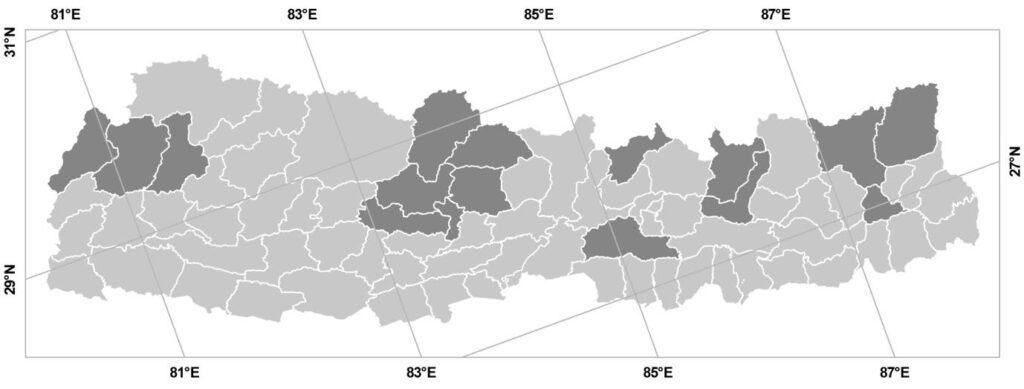
Altitudinal range: 1800–4000 m.
Ecology: Coniferous or broadleaved forests, bamboo thickets, hillsides along streams, alpine grasslands.
Flowering: May–August. Fruiting: August–September.