
3. Gagea Salisb., Ann. Bot. (König & Sims) 2: 555 (1806).
Taxon Description
Perennial herbs. Bulbs small, ovoid or globose, covered with tunics; tunics generally with a collar of persistent leaf bases. Scapes erect, simple, glabrous or pubescent. Leaves basal, 1 to several, shorter than, almost equalling, or sometimes longer than scapes, sessile, often filiform; blade linear to linear-lanceolate, glabrous or pubescent, apex acute or blunt, margin entire, veins parallel. Inflorescences single terminal flower, or few to many-flowered terminal umbel or raceme; bracts 2 or few, unequal, leaf-like, linear to very narrowly lanceolate, or filiform with sheathing base, apex acute or blunt, veins prominent. Flowers bisexual, actinomorphic, usually stellate or star-like, when fully expanded, or funnel-shaped or campanulate, mottled with various colours erect or drooping; pedicellate. Tepals 6, white or yellow, free, in two whorls, either equal, or unequal in size, if unequal outer tepals wider than inner, persistent; basal nectaries may or may not present adaxially, if present usually fringed with fine hairs. Stamens 6, shorter than tepals, sub-hypogynous, inserted at base; filaments filiform, sometimes pubescent; anthers basifixed. Ovary small, ovoid to oblong, 3-loculed, many ovules per locule; style usually long, straight, thick; stigma capitate or scarcely 3-lobed. Fruit a loculicidal capsule, usually erect splitting from apex. Seeds many, globose to flattened.
Taxon Statistics
About 280 species from temperate and subarctic regions of the N Hemisphere. Seven or possibly eight species in Nepal.
Recently, Patil (2022) proposed transfer of seven Lloydia Salisb. ex Rchb. into Gagea Salisb. Several molecular studies based on different datasets (various plastid regions, and ITS nrDNA) also support grouping of Gagea and Lloydia (Patterson & Givnish, 2002; Peterson et al., 2004; Peterson & Peterson, 2005, 2006; Rønsted et al., 2005). Moreover, Zarrei et al. (2009) through extensive molecular analysis of plastid and ITS nrDNA sequences confirmed the monophyly of Gagea sensu lato (s.l.) and confirmed that neither genus is monophyletic relative to the other. Considering this, in the present account, we have treated all the Lloydia species found in Nepal under Gagea s.l., as they are already transferred to the later genus.
Gagea nakaiana Kitag. is a doubtful species for Nepal. Patil (2022) has designated the Gagea himalensis (Royle) to Gagea s.l., where distribution range includes Nepal as well. However, no herbarium specimen was studied from Nepal in the mentioned article. Previously, it was treated as either synonym for G. serotina or as unplaced/unresolved taxa.
Key to Species
1 a. Basal leaves exceeding scapes; flowers erect…………………………………………………………………………………………………………………………2
b. Basal leaves shorter or equalling scapes; flowers drooping……………………………………………………………………………….……………………3
2 a. Tepals yellow, or yellow-green, equal, oblong to obovate……………………………………………………………………………………..…… G. lutea
b. Tepals white with prominent purplish midrib reaching apex, unequal, oblong to narrowly elliptic……..…………………3. G. noltiei
3 a. Style < 5 mm; basal nectaries present adaxially in tepals………………….………………………………………………………………………………..….4
b. Style > 7 mm; nectaries absent in tepals…………………………………………………………………………………………………….7. G. yunnanensis
4 a. Basal leaves > 2 in number; filaments hairy……………………………………………………………………………………………………………………………5
b. Basal leaves 1 or 2 in number; filaments glabrous……………………………………………………………………………………………..4. G. serotina
5 a. Pedicel > 1 cm; flowers yellow; tunics size < 3 cm; stigma 3-lobed or capitate………………………………………………………………………..6
b. Pedicel < 1 cm; flowers white; tunics size > 3 cm; stigma capitate………………………………………………………………….…5. G. lasiantha
6 a. Scapes pubescent in upper parts; bracts > 0.1 cm long; tepals with orange or brownish spots at base…………. G. flavonutans
b. Scapes glabrous; bracts < 0.1 cm long; tepals with purplish green veins…………………………………………………………….6. G. tibetica
1. Gagea flavonutans (H.Hara) Zarrei & Wilkin, Phytotaxa 15: 53 (2011).
Lloydia flavonutans H.Hara, J. Jap. Bot. 49: 202 (1974). Lloydia delavayi sensu H.Hara, Fl. E. Himal. 1: 408 & 655, f. 63f. (1966), non Franch., J. Bot. (Morot) 12: 193 (1898).
Perennial herbs, 6–15(–20) cm tall. Bulbs ovoid, 1–1.2 × 0.6–0.8 cm, covered with whitish tunics, 1.8–3 cm. Scapes pubescent with short white hairs in upper part. Leaves basal, 5 or upto 9, sessile, linear-filiform, shorter than or equalling scape, 4–13(–15) × 0.05–0.2 cm, apex blunt, margin entire, glabrous or minutely pubescent, veins parallel. Inflorescences single terminal flower or flowers upto 3; bracts 2–4, leaf-like, linear, 1.5–3 × 0.1–0.2 cm, margin glabrous or ciliate, apex blunt. Flowers bisexual, actinomorphic, campanulate, drooping; pedicel 1–1.4 cm, usually sparsely white hairy. Tepals yellow with orange or brownish spots at the base, unequal, outer oblong, 1.2–1.6 × 0.3–0.4 cm, inner obovate to elliptic, 1.2–1.8 × 0.5–0.8 cm, base and apex sometimes slightly contracted; basal nectaries absent. Filaments linear, 3–6 mm, with spreading hairs; anthers oblong, 1.5–2 mm, basifixed. Ovary oblong-ovoid, 3–4 × 1–1.5 mm; style 3–4 mm; stigma capitate or 3-lobed, scarcely developed. Capsule loculicidal, oblong, 7–10 × 3–4 mm. Seeds oblong, ca. 3.2 mm, winged.
Distribution: Nepal, E Himalaya, Tibetan Plateau, and Assam–Burma.
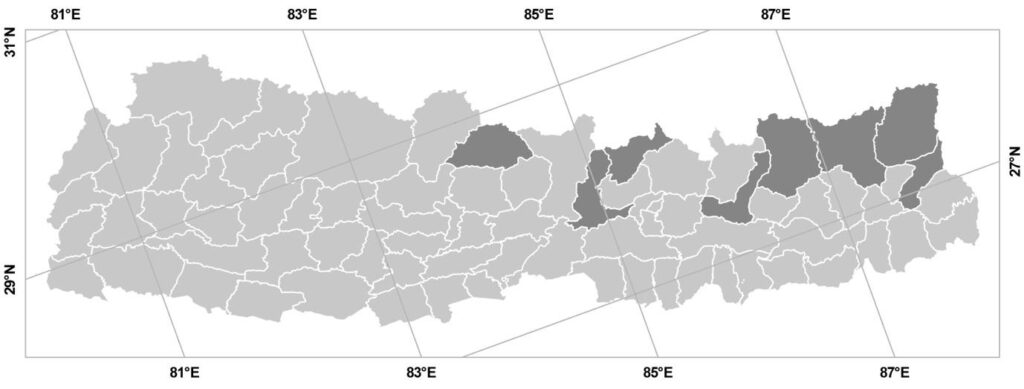
Altitudinal range: 3500–5200 m.
Ecology: Alpine grassy and rocky meadows, thickets.
Flowering: May–July (–August). Fruiting: August–September.
2. Gagea lutea (L.) Ker-Gawl., Bot. Mag. 30: t. 1200 (1809).
Ornithogalum luteum L., Sp. Pl.: 306 (1753); Gagea elegans Wall. ex G.Don
खिरौँला Khiraunlaa (Nepali), Yellow star-of-Bethlehem (English).
Perennial herbs, ca. 5–15 cm tall. Bulbs ovoid, 0.5–1.2 × 0.6–1 cm, covered with thin, papery or membranous tunics, ca. 1.2 cm. Scapes unbrached, glabrous or pubescent with scattered whitish hairs above. Leaves basal, single, sessile, linear to linear-lanceolate, narrowed towards base, exceeding scape, 15–22 × 0.2–1 cm, apex acute to subacute, margin entire, glabrous or minutely pubescent, veins parallel. Inflorescences single-flowered or up to 4(–6)-flowered umbels; bracts usually 2, sub-opposite, subtending the inflorescence, leaf-like, sheathing at base, unequal, inner lanceolate, 2–5 × 0.2–1 cm, overtopping the inflorescence, outer linear, 0.9–2.3 × 0.05–0.3 cm, apex acute, surface glabrous or pubescent with short white hairs, veins prominent; bracteoles sometimes present, linear to filiform, 0.9–1.8 cm long, usually pubescent. Flowers bisexual, actinomorphic, star-shaped, erect; pedicel slender, 1.5–4 cm long, glabrous or pubescent above. Tepals yellow, or yellow-green, oblong to obovate, equal, 1–1.8 × 0.2–0.3 cm, subacute to acute at apex. Filaments slender, 8 mm, hairy at base; anthers oblong, ca. 1 mm, basifixed. Ovary ovoid or obovoid, 3-loculed, ca. 2 mm; style 5–6 mm; stigma 3-lobed. Capsule loculicidal, oblong, 6 mm or shorter. Seeds flat, wingless.
Distribution: Nepal, W Himalaya, E Himalaya, SW Asia, E Asia, N Asia, C Asia, and Europe.
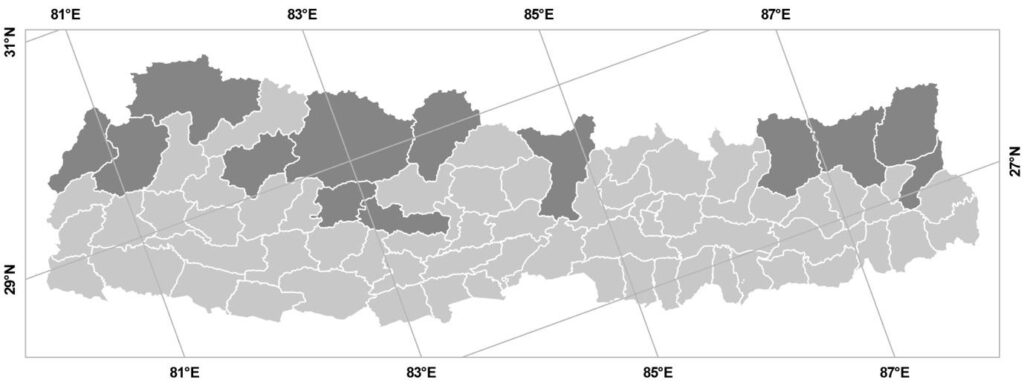
Altitudinal range: 2800–4300 m.
Ecology: Broadleaved forest, alpine thickets, pastures, rocky or grassy slopes.
Flowering: March–June. Fruiting: May–July.
Bulbs and young leaves are used as food-famine.
3. Gagea noltiei Peruzzi, J.-M.Tison, A.Peterson & J.Peterson, Taxon 57(4): 1212 (2008).
Lloydia delicatula Noltie, Edinburgh J. Bot. 50: 55 (1993).
Perennial herbs, 1–3 cm tall. Bulbs densely clumped, narrowly ovoid, 3–5 × 3 mm, covered with light pale brown, papery tunics, 0.5–2 cm. Scapes very slender, unbrached, glabrous. Leaves basal, single, linear-filiform, 1.5–3 × 0.05 cm, exceeding scapes, apex blunt, margin entire, veins parallel. Inflorescences single terminal flower, erect; bracts 3 or sometimes 2, linear, 3–8 × 0.5–1 mm, leaf-like, apex blunt, margin scarious narrow, lower two bracts usually subopposite, upper one somewhat smaller. Flowers bisexual, actinomorphic, campanulate, erect; pedicel 1–2 mm. Tepals white or rarely suffused purplish, oblong to narrowly elliptic, 3.5–6 × 1–2 mm, outer slightly broader than inner, base narrow, apex subacute; veins 3, purplish, midvein prominent reaching apex; basal nectaries present adaxially, round or transversely elongate, conspicuous, located about a quarter of way from base of tepals. Filaments 2.5–3 mm, glabrous; anther rounded or nearly circular, ca. 0.4–0.8 mm at maturity, basifixed. Ovary narrowly ellipsoid to oblong-ovoid, 1.5–2 × 0.8–1.2 mm; style 1.2–2 mm; stigma ± capitate. Capsule loculicidal, ca. 2.8 × 1.9 mm. Seeds oblong, winged.
Distribution: Nepal and E Himalaya.
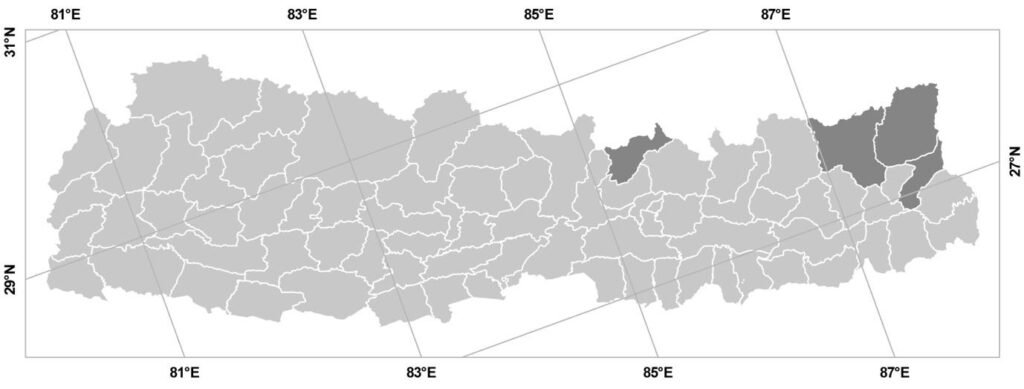
Altitudinal range: 3500–4700 m.
Ecology: Forest floor, open slopes, meadows, screes, and rock ledges.
Flowering: June–July. Fruiting: July–August.
4. Gagea serotina (L.) Ker-Gawl., J. Sci. Arts (London). 1: 180 (1816).
Bulbocodium serotinum L., Sp. Pl.: 294 (1753); Lloydia serotina (L.) Rchb., Fl. Germ. Excurs.: 102 (1830); Lloydia serotina f. parva C.Marquand & Airy-Shaw; Lloydia serotina var. parva (C.Marquand & Airy-Shaw) H.Hara
सानो काकोली Saano kaakoli (Nepali); Common alplily, Snowdon lily (English).
Perennial herbs, 2.5–20(–25) cm tall. Bulbs ovoid, or somewhat elongated, 0.8–1.5 × 0.4–1 cm, covered with pale tunics, 1.5–6 cm. Scapes unbrached, glabrous. Leaves basal, 1 or 2, sessile, linear-filiform, shorter or equals to scape, 2.5–20 × 0.05–0.15 cm, apex blunt, margin entire, veins parallel. Inflorescences single terminal flower, or rarely 2-flowered; bracts 3–5, leaf-like, linear to narrowly lanceolate, 0.4–3.5 × 0.05–0.25 cm, apex blunt, margin narrowly membranous, base partially clasping. Flowers bisexual, actinomorphic, campanulate, ± erect; pedicel 0.3–1.5 cm. Tepals white, rarely suffused purplish, narrowly elliptic to obovate-oblong, 0.4–1.8 × 0.1–0.8 cm, outer slightly broader than inner, apex rounded to subacute, veins > 3, purplish, midvein prominent ± reaching apex; basal nectaries very small, yellowish, present adaxially, 1.5–2.5 mm from base of tepals. Filaments 1.5–7 mm, glabrous; anthers oblong, 0.5–2 mm, basifixed. Ovary obovoid or narrowly so, 1–5 × 1–1.5 mm; style 1–4 mm; stigma capitate or indistinctly 3-lobed. Capsule loculicidal, oblong-ovoid, 3–7 mm. Seeds many, crescent-shaped-deltoid, flat.
Distribution: Nepal, W Himalaya, E Himalaya, Tibetan Plateau, S Asia, C Asia, E Asia, N Asia, Europe, Africa, and N America.
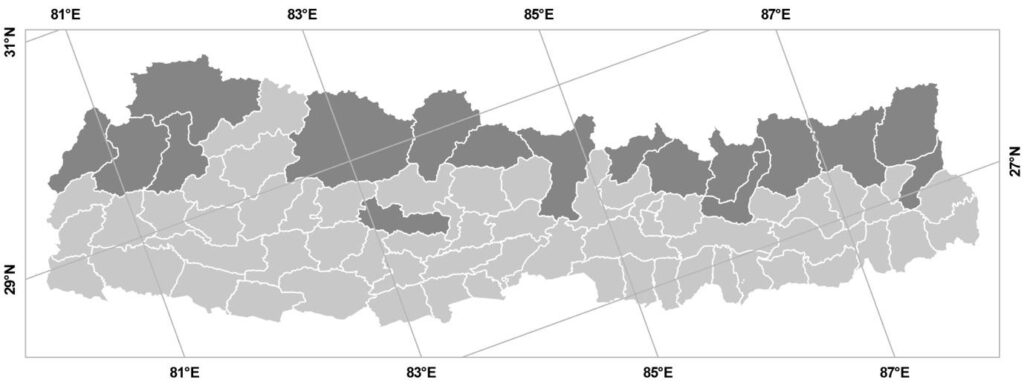
Altitudinal range: 3300–4900 m.
Ecology: Alpine meadows, among grasses and rocks, sometimes in rock ledges and cliffs, thickets.
Flowering: (May–) June–August. Fruiting: August–October.
Bulbs, leaves, and fruit of the species are used for medicinal purposes.
5. Gagea lasiantha Sameer-Patil, J. Jpn. Bot. 97(2): 91 (2022).
Lloydia longiscapa Hook.; Gagea pulchella Wall., nom. inval.
Perennial herbs, 12–30 cm tall. Bulbs clumped, usually ovoid, 1.5–2 × 0.8–1.3 cm; covered with tunics, 3–5(–6) cm. Scapes unbrached, glabrous. Leaves basal, upto 6 in number, sessile, linear, filiform, shorter than scape, 10–24 × 0.1–0.15 cm, apex blunt, margin entire, veins parallel. Inflorescences single terminal flower or 2–3-flowered raceme; bracts upto 5, leaf-like, linear, 1.5–6 × 0.1–0.15 cm, apex blunt. Flowers bisexual, actinomorphic, campanulate, drooping; pedicel 5–10 mm. Tepals white with orange or brownish or reddish basal shade on lower half of tepals, and veins of same colour on upper half, lanceolate to elliptic, unequal, outer 1.2–2 × 0.4–0.7 cm, inner 1.2–2 × 0.4–0.6 cm; basal nectaries present adaxially, surrounded by hairs. Filaments 3–6 mm, with spreading hairs; anther oblong, ca. 1.2 mm. Ovary ovoid, 3–5 × 1.5–2 mm; style 3–5 mm; stigma capitate. Capsule loculicidal, erect splitting from apex. Seeds numerous.
Distribution: Nepal, W Himalaya, E Himalya, and Assaam–Burma.
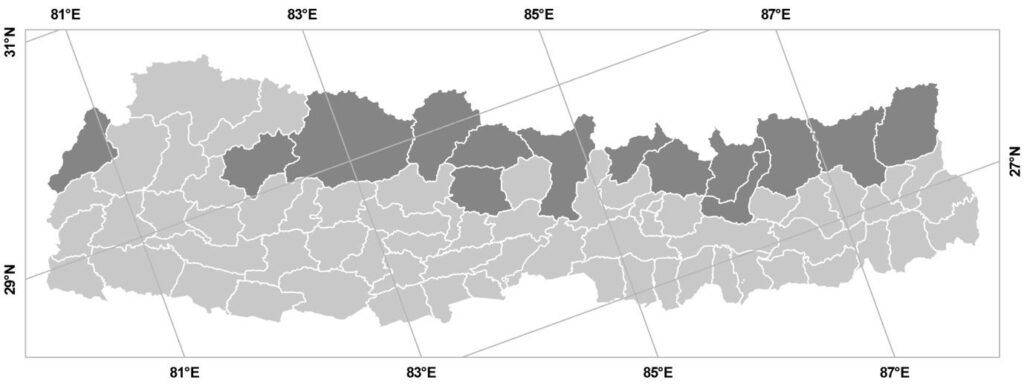
Altitudinal range: (2500–)3600–5000 m.
Ecology: Thickets, grassy slopes, alpine scrub, meadows, mossy rocks, cliffs.
Flowering: May–June (–August). Fruiting: August.
Bulbs are used for medicinal purposes.
6. Gagea tibetica (Baker ex Oliv.) Sameer-Patil, J. Jpn. Bot. 97(2): 94 (2022).
Lloydia tibetica Baker ex Oliv. in Hook., Icon. Pl. 23: t. 2216 (1892).
Perennial herbs, 12–26 cm tall. Bulbs small, 1–1.5 × 0.6–1 cm; covered with tunics, 1.5–2.5 cm Scapes unbrached, glabrous. Leaves basal, 3–10 in number, sessile, narrowly linear, fliliform, shorter than or equalling scapes, 11–25 × 0.1–0.25 cm, apex blunt, margin entire, veins parallel. Inflorescences 1–5-flowered raceme; bracts 2 or 3 in number, leaf-like, narrowly linear, 1.2–2.5 × 0.05–0.1 cm, apex blunt. Flowers bisexual, actinomorphic, campanulate, drooping; pedicel 1–1.5 cm. Tepals yellow with purplish green veins, unequal, outer suboblong, 1.2–2 × 0.3–0.6 cm, inner narrowly elliptic, 1.2–2 × 0.6–0.9 cm; basal nectaries present adaxially, surrounded by small hairs. Filaments yellow, 6–8 mm, subtended with dense hairs; anthers yellow, 1–2 mm. Ovary ovoid, 3–4 mm; style ca. 4 mm; stigma capitate or obscurely 3-lobed. erect splitting from apex. Capsule loculicidal, erect splitting from apex. Seeds numerous.
Distribution: Nepal, E Himalaya, Tibetan Plateau, and E Asia.
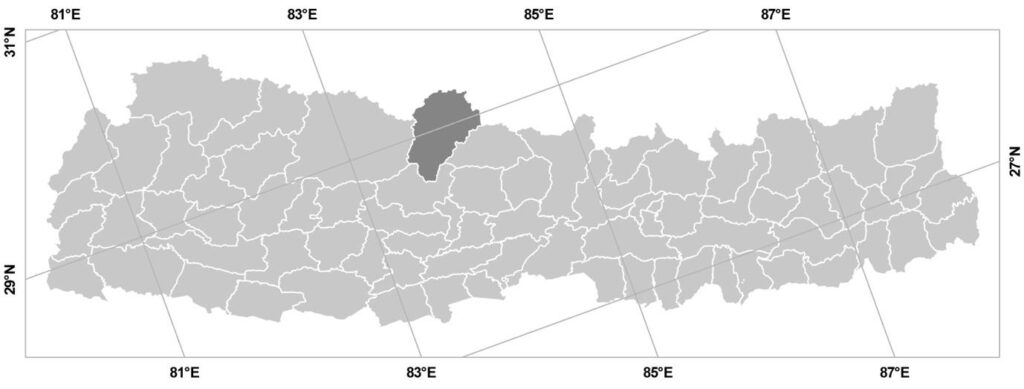
Altitudinal range: 2300–4100 m.
Ecology: Shady slopes, mossy rock edges, grasslands.
Flowering: May–July. Fruiting: July–August.
7. Gagea yunnanensis (Franch.) Sameer-Patil, J. Jap. Bot. 97(2): 94 (2022).
Lloydia yunnanensis Franch., J. Bot. (Morot) 12: 192 (1898); Lloydia filiformis Franch.; Lloydia mairei H. Lév.
Perennial herbs, 10–30 cm tall. Bulbs densely clumped, 5–12 × 3–4 mm; covered with brown tunics. Scapes unbrached, glabrous. Leaves basal, 1 or 2 in number, shorter than scapes, sessile, linear, filiform, 0.5–1 mm wide, apex blunt, margin entire, veins parallel. Inflorescences single terminal flower; bracts upto 5 in number, linear, leaf-like, small, 0.8–1.5 × 0.5–0.8 cm, apex blunt. Flowers bisexual, actinomorphic, campanulate, drooping; pedicel ca. 5 mm. Tepals white with orange, reddish brown basal spots, and veins of same colour on upper parts, unequal, outer oblong, 1.7–2 × 0.3–0.4 cm, inner oblanceolate, 1.7–2 × 0.4–0.6 cm. Filaments 4–6 mm, glabrous; anthers linear-oblong, 2–2.5 mm. Ovary narrowly obovoid, 3–4 × 1.5 mm; style 0.7–1 cm; stigma 3-lobed. Capsule loculicidal, erect splitting from apex. Seeds numerous.
Distribution: Nepal, E Himalaya, and E Asia.
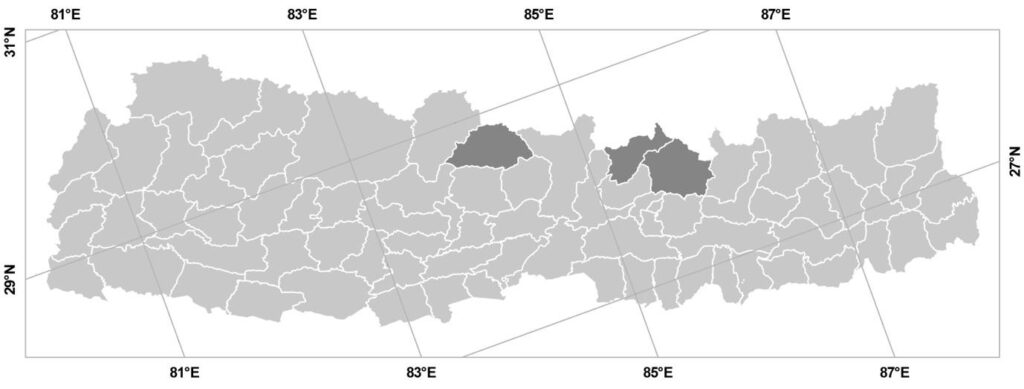
Altitudinal range: 2300–4300 m.
Ecology: Forest margins, scrub, shady places on slopes, grasslands, damp mossy rocks along valleys.
Flowering: June–July. Fruiting: July–August.